Heart Health Tests Beyond a Standard Lipid Profile

A normal cholesterol test does not always mean your heart is healthy. Some people may need additional blood tests to get a clearer picture of their heart disease risk. Although lipid profile remains the foundation for assessing cardiovascular risk, tests like ApoB, hs-CRP, and lipid ratios can in some times give a better picture of your heart disease risk. ApoB checks harmful cholesterol particles, hs-CRP looks for hidden inflammation, and lipid ratios help assess your overall heart health. Doctors use these test results along with your medical history and overall health to decide the right care.
A normal cholesterol report does not always mean your heart is fully safe. Some people have normal basic results but still have hidden heart risk. That is why doctors may suggest extra blood tests such as ApoB, hs-CRP, and lipid ratios.
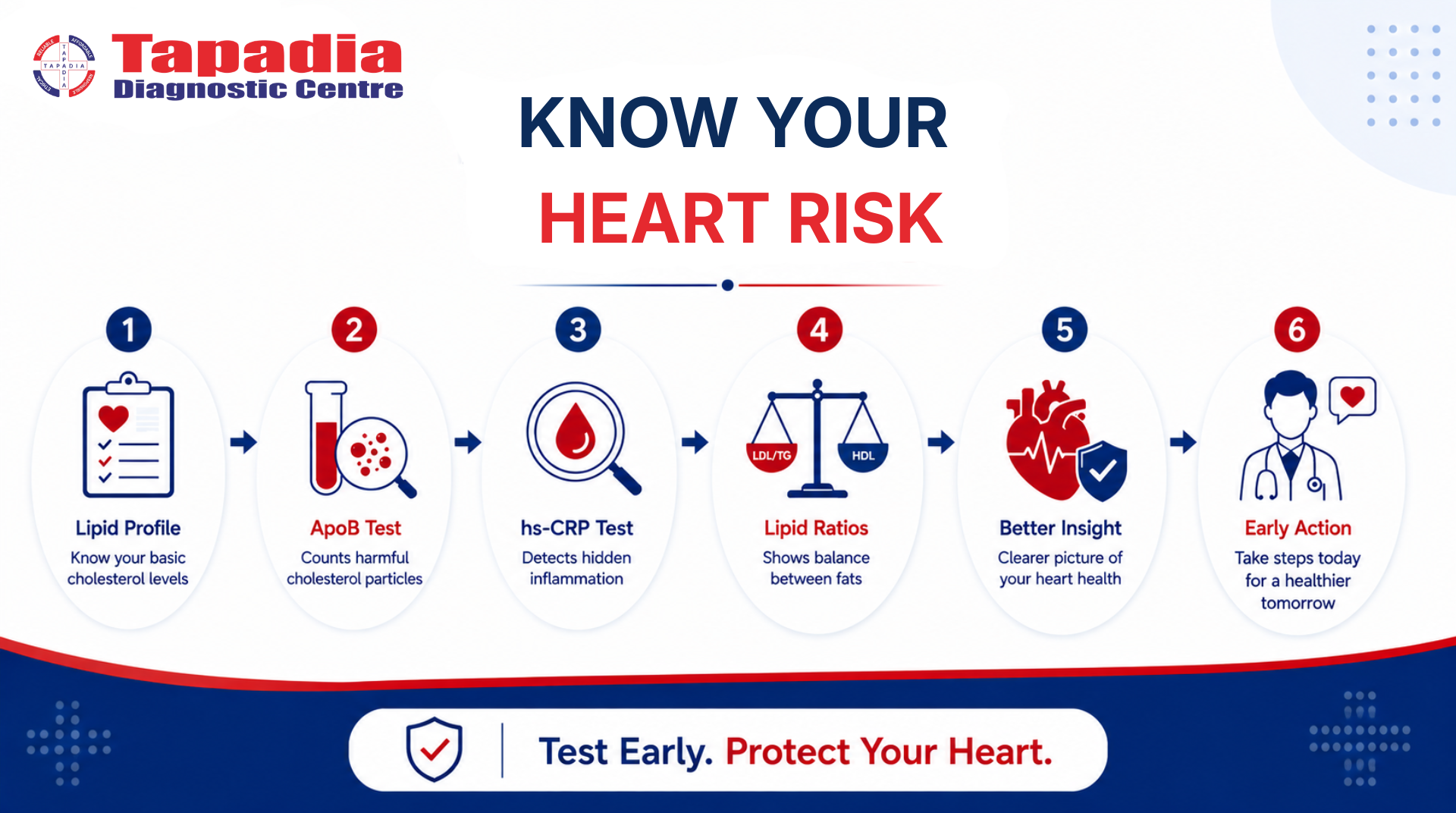
These tests help show things that a standard lipid profile can miss, such as harmful cholesterol particles, inflammation, and how different fat levels work together. When used with your medical history and lifestyle, they can give a clearer picture of your heart health.
Why a standard lipid profile may not be enough
A standard lipid profile is a common blood test for checking cholesterol and is the foundation for assessing cardiovascular risk. It usually measures:
Total cholesterol: The total amount of cholesterol in your blood.
LDL cholesterol: The type that can build up in your arteries.
HDL cholesterol: The type that helps clear extra cholesterol from your blood.
Triglycerides: A type of fat in your blood.
This test is useful, but it does not show everything. It does not clearly show:
How many harmful cholesterol particles are present.
Whether there is hidden inflammation in your blood vessels.
Other signs that may increase heart disease risk.
Because of this, some people can have normal cholesterol levels and still have a higher chance of heart problems. Extra testing can help doctors look deeper.
Looking Beyond Cholesterol ? Tapadia Diagnostic offers Advance Heart Health Blood Tests
What are advanced cardiac risk tests?
Advanced cardiac risk tests are blood tests that go beyond basic cholesterol numbers. They help doctors understand hidden risk factors linked to heart disease.
Three common examples are ApoB, hs-CRP, and lipid ratios. Each one gives different information about your heart risk.
1. ApoB blood test
What is ApoB?
ApoB is a protein found on harmful fat particles in your blood. These particles can cause fat buildup in your blood vessels.
Why does it matter?
Each harmful particle has one ApoB protein. This test helps show how many harmful particles may be in your blood.
Higher ApoB levels may mean:
You have more harmful cholesterol particles.
You may have a greater chance of plaque buildup in the arteries.
Who may benefit from an ApoB test?
People with a family history of early heart disease.
People with diabetes or metabolic syndrome.
People with high triglycerides.
People whose basic cholesterol results look borderline or confusing.
2. hs-CRP test
What is hs-CRP?
hs-CRP is a blood test that looks for inflammation in the body. Inflammation can affect blood vessels and may raise heart risk.
Why does inflammation matter?
Heart disease is not only about cholesterol. Inflammation can make fat buildup in the blood vessels more dangerous. This can increase the chance of a serious heart problem.
Understanding hs-CRP levels
hs-CRP Level | Risk Level | What It May Mean |
Low | Lower risk | Less sign of heart-related inflammation |
Moderate | Average risk | Some inflammation may be present |
High | Higher risk | More inflammation and needs medical review |
Note: hs-CRP can rise for reasons other than heart disease, such as infection, injury, or a recent illness and should be interpreted by a medical professional in the right clinical context.
3. Lipid ratios
Lipid ratios compare one cholesterol number with another. This can help doctors understand the balance between protective and harmful fats.
Total cholesterol / HDL ratio: Compares total cholesterol with good cholesterol.
LDL / HDL ratio: Compares bad cholesterol with good cholesterol.
Triglyceride / HDL ratio: Can help show problems linked to metabolic health and insulin resistance.
Doctors use these ratios along with other test results to better understand overall heart risk.
Quick comparison: standard vs. advanced tests
Test Type | Detects | Why It Matters |
|---|---|---|
Lipid Profile | Basic cholesterol levels | Gives a starting point for heart-risk review |
ApoB Test | Number of harmful particles | Shows how many plaque-forming particles are present |
hs-CRP Test | Inflammation in the body | Helps find hidden inflammation linked to heart problems |
Lipid Ratios | Balance between different fat levels | Helps doctors read cholesterol results more clearly |
Who may need these tests?
These tests may be helpful for people who have:
A family history of early heart disease or stroke.
Diabetes, high blood pressure, or obesity.
High triglycerides or a history of smoking.
Normal basic cholesterol results but other lifestyle or medical risk factors.
Can these tests predict a heart attack?
No single blood test can predict a heart attack with certainty.
These tests help estimate overall risk. A doctor still needs to review your symptoms, history, lifestyle, and other results before making a diagnosis or treatment plan.
How to get ready for the test
Fasting: Follow the instructions given by your doctor or the testing centre. Usually for a lipid profile, 10 to 12 hours of fasting is recommended.
Hydration: Drink water unless you are told not to.
Medicines: Tell your doctor about the medicines and supplements you take.
Key takeaways
Basic cholesterol tests do not show everything: They may miss hidden particle risk and inflammation.
ApoB gives extra detail: It helps show how many harmful cholesterol particles are present.
hs-CRP looks at inflammation: This can be an important part of heart disease risk.
Lipid ratios add context: They help doctors understand how your cholesterol numbers work together.
These tests support earlier action: They can help guide prevention when used with medical advice.
Frequently asked questions
This can happen when the amount of cholesterol looks normal, but the number of harmful particles is still high. More particles can mean a higher chance of plaque entering artery walls.
The right plan depends on the cause. Your doctor may suggest steps such as improving diet, exercising regularly, stopping smoking, sleeping better, and managing conditions like diabetes or obesity.
That depends on your health history, your risk factors, and whether you are already being treated for cholesterol or inflammation issues. Your doctor can guide the timing. Doctors interpret laboratory findings with age, blood pressure, smoking, diabetes, kidney disease, family history, and a validated risk calculator. In selected adults, a coronary artery calcium scan may help when a treatment decision remains uncertain. The 2026 guideline summary emphasises newer risk equations and selective calcium scoring.
Disclaimer: Content is for informational and educational purposes only and does not substitute for professional medical advice, diagnosis, or targeted clinical treatment. For any health related concerns or symptoms please seek advice from a qualified medical professional.

We also provide Home diagnostic services