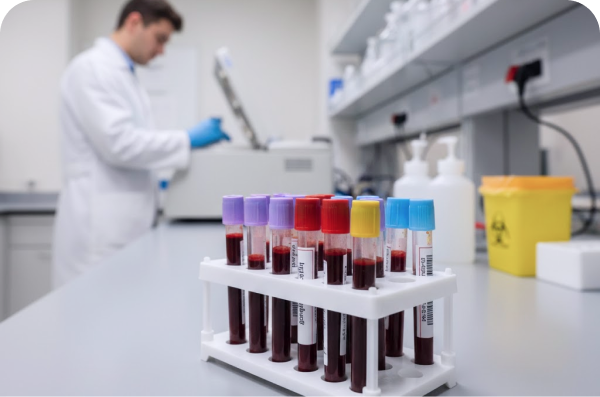


Know More About This Test
The D-Dimer test measures a protein fragment produced when a blood clot dissolves in the body. Under normal circumstances, D-dimer levels remain low. Elevated levels indicate increased clot formation and breakdown, suggesting an active or recent clotting process.
This test is widely used to help rule out serious clot-related conditions such as deep vein thrombosis (DVT), pulmonary embolism, and disseminated intravascular coagulation (DIC).
Why Is This Test Recommended?
It is recommended for patients with sudden leg swelling, chest pain, breathlessness, or suspected clotting disorders.
It is also used in hospitalized or post-surgical patients who are at higher risk of thrombosis.
Symptoms or Conditions That May Require a D Dimer Quantitative Test
You may need this test if you experience:
Unexplained swelling, pain, warmth, or redness in one leg - characteristic signs of DVT
Sudden onset of shortness of breath, chest pain, rapid heartbeat, or coughing up blood - warning signs of pulmonary embolism
Symptoms of deep vein thrombosis or pulmonary embolism, particularly in those with a recent history of immobility or surgery
Unexplained bruising, bleeding from multiple sites, or signs of abnormal clotting suggesting DIC
A recent history of prolonged bed rest, long-haul travel, surgery, or hospitalization that increases clot formation risk
Known or suspected cancer, as malignancy is a well-established risk factor for thromboembolism and is associated with elevated D-dimer levels
Advantages of the D Dimer Quantitative Test
Unlike a qualitative D-dimer test that simply returns a positive or negative result, the quantitative assay provides an exact numerical concentration - giving clinicians the ability to correlate the degree of elevation with the severity of the clotting process, monitor treatment response over time with serial testing, and make more nuanced decisions about the urgency of further investigation.
The test relies on automated, quantitative immunoassay analysers to ensure rapid and accurate measurement.
It is quick, minimally invasive, and does not require fasting, making it ideal for emergency and outpatient settings alike.
Its high negative predictive value - particularly its ability to reliably rule out DVT and PE when results are normal - makes it one of the most cost-effective first-line diagnostic tools in clinical medicine.
How Is the Test Performed and Prepared For?
A blood sample is collected from a vein. No fasting is required. Ongoing anticoagulant therapy should be reported.
What Do the Results Mean?
Results are typically reported in fibrinogen equivalent units (FEU), most commonly in micrograms per millilitre (µg/mL FEU) or nanograms per millilitre (ng/mL FEU).
While reference ranges may vary slightly between laboratories, a commonly accepted cutoff is:
Normal / Negative (Low Risk): ≤ 0.50 µg/mL FEU - a normal or low D-dimer level usually means there is no significant clot formation or breakdown happening.
In patients with low to moderate risk of conditions like DVT or PE, a normal result can help rule out these issues without needing further imaging.Elevated / Positive: Above 0.50 µg/mL FEU a positive D-dimer result may be indicative that the body is experiencing significant blood clot formation and breakdown, causing an abnormally high level of fibrin degradation products.
However, this is not diagnostic on its own and requires correlation with clinical findings and imaging.Markedly Elevated: Very high quantitative values are associated with conditions such as DIC, extensive DVT, massive PE, or widespread malignancy, and require urgent clinical evaluation.
Lifestyle Tips to Reduce Blood Clot Risk
Stay physically active and avoid prolonged periods of immobility.
Stay well hydrated, as dehydration thickens the blood and increases the tendency for clot formation, particularly during travel or illness.
Maintain a healthy weight, as obesity is a significant independent risk factor for DVT and pulmonary embolism.
If you are on anticoagulant therapy, take your medications exactly as prescribed and never miss a dose without consulting your doctor first.
Quit smoking, as smoking damages blood vessel walls and significantly increases the risk of abnormal clot formation throughout the body.
Frequently Asked Questions (FAQs)
Is D-dimer specific for clots?
No, D-dimer is not specific for blood clots alone, as elevated levels can also occur due to other conditions like inflammation, surgery, or cancer, so it must be interpreted alongside clinical symptoms and other tests for accurate diagnosis.Can infection increase D-dimer?
Yes, infections can significantly increase D-dimer levels because they trigger widespread inflammation and clotting activity in the body, mimicking the effects of actual thrombosis.Does pregnancy affect levels?
Yes, pregnancy naturally elevates D-dimer levels due to increased blood clotting factors and vascular changes to support the fetus, so results in pregnant individuals require careful interpretation with adjusted reference ranges.Is imaging still required?
Often, yes - while a normal D-dimer can help rule out clots, an elevated result typically requires follow-up imaging like ultrasound or CT scans to confirm or exclude conditions such as DVT or pulmonary embolism.Can levels normalize after treatment?
Yes, D-dimer levels can normalize after effective treatment of the underlying clot or condition, usually within days to weeks, serving as a useful marker to monitor recovery and ensure no ongoing thrombosis.