

Exercise Stress Test in Warangal
Also called: Exercise stress test, Stress EKG, Stress test
- SAMPLE
- Not required
- Report
- Same or next day
- PREPARATIONS
- Comfortable clothing, light meal
The Scan at a glance
- What it checks
- Tread Mill Test (TMT) test is a clinically significant diagnostic investigation used to evaluate, screen, or monitor underlying health conditions. It provides actionable insights that support early diagnosis, treatment planning, and long-term disease management.
- Report delivery
- For report delivery timelines, please contact the front desk or call +91 93901 10089.
- Test for
- Men, Women
- Age group
- All
- Commonly advised for
- Chest pain, shortness of breath, dizziness, fatigue
- Home collection
- No
What is a Complete Blood Count?
Treadmill Test (TMT) / Exercise Stress Test
The Treadmill Test (TMT), also known as an Exercise Stress Test or Treadmill ECG Stress Test, is a non-invasive diagnostic procedure used to see how your heart responds to physical activity. By monitoring your heart’s electrical activity, heart rate, and blood pressure while you walk on a treadmill, doctors can assess how well your heart copes with increased workload.
This test is a crucial component of many comprehensive health check packages. It is recommended for people at risk of heart disease, as well as those having symptoms that may suggest a heart problem.
Purpose and need for the TMT test
The primary purpose of the TMT test is to examine the heart's function under stress. During a workout, the heart requires more blood that is rich in oxygen. If there is a blockage in the coronary arteries, the extra blood supply required during the test may not be given, and this can be a signal during the test.
The TMT test is useful for:
- Detecting coronary artery disease (CAD): Helps find reduced blood flow due to narrowed or blocked arteries. A positive test can suggest that the heart is not getting enough blood during exercise.
- Evaluating symptoms: Helps determine if chest pain, breathlessness, or dizziness are related to heart disease, especially when they occur during exertion.
- Assessing treatment effectiveness: Used in people with known heart disease to evaluate how well medicines or procedures like angioplasty are working.
- Diagnosing exercise-induced arrhythmias: It can help detect abnormal heart rhythms that appear only during physical activity.
- Determining fitness and risk: Assesses exercise capacity and heart response before surgery or before starting an intensive exercise program.
- Planning treatment: Results help doctors decide the next steps in managing heart conditions.
Procedure overview The TMT is performed in a lab or clinic under close medical supervision.
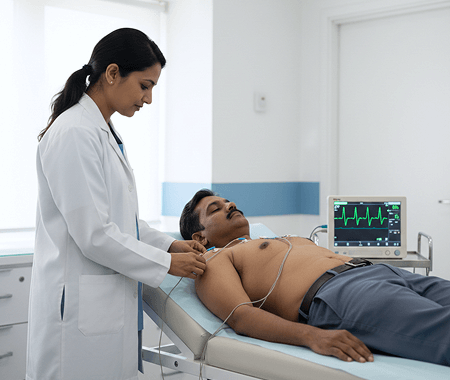
- Preparation phase: Electrodes are attached to your chest and connected to an ECG machine.
- Your resting heart rate, blood pressure, and ECG are recorded.
- Exercise phase: You begin walking on a motorized treadmill.
- The speed and incline are increased gradually in stages (often following a recognized protocol such as the Bruce protocol).
- This stepwise increase raises the stress on your heart.
- Monitoring during the test: Your ECG, heart rate, blood pressure, and symptoms are continuously monitored.
- You will be asked how you feel during each stage, especially regarding chest pain, breathlessness, or fatigue.
- Termination of the test: The test may be stopped if: You reach your target heart rate.
- You develop significant symptoms, such as chest pain, severe shortness of breath, or extreme fatigue.
- The doctor sees concerning ECG changes or blood pressure responses (for example, a marked drop in blood pressure).
- Recovery phase: After stopping the treadmill, you will continue to be monitored while you rest.
- Heart rate and blood pressure are observed for several minutes to see how quickly they return to baseline.
Preparing for your TMT test
Proper preparation helps ensure accurate and safe results.
Do’s:
- Wear comfortable clothing: Choose loose-fitting clothes and good walking or running shoes.
- Discuss medications: Inform your doctor about all medicines. In some cases, certain heart or blood pressure drugs may be paused before the test.
- Follow fasting advice: You are often advised not to eat or drink for 2 to 4 hours before the test to avoid nausea during exercise.
Don’ts:
- Avoid caffeine and nicotine: Stay away from coffee, tea, cola drinks, chocolate, and tobacco products for at least 24 hours, as they can affect heart rate and blood pressure.
- Avoid undue stress: Try to remain calm, as anxiety can raise your heart rate and alter results.
Interpreting TMT results
- Negative TMT result: Suggests that the heart functioned normally under stress and that the likelihood of significant coronary artery disease is lower.
- Positive TMT result: Indicates that the heart may not be receiving enough blood during exercise, often due to narrowed or blocked coronary arteries. Further tests, such as echocardiography or coronary angiography, may be recommended.
- Borderline or equivocal result: Means that while overall performance (for example, in METS achieved and heart rate) may be acceptable, there are some atypical findings, such as unusually high blood pressure at peak exercise, which may require additional evaluation.
Reports usually include:
- METS (Metabolic Equivalents), which reflect exercise capacity.
- Heart rate recovery which is the difference between peak heart rate and heart rate one minute after exercise stops.
Safety and contraindications The TMT is generally safe, and serious complications are rare. However, possible issues include temporary low blood pressure or irregular heartbeats, which usually resolve with rest.
The test may not be recommended for people with:
- Recent heart attack (within the last 2 to 3 days).
- Unstable angina (chest pain that is not well controlled).
- Uncontrolled symptomatic heart failure.
- Symptomatic severe aortic stenosis.
- Severe, uncontrolled high blood pressure (for example, very high systolic or diastolic pressure).
Your healthcare provider will decide whether a TMT is appropriate based on your medical history and current condition.
FAQs 1. Is there anything that I should not do before the Treadmill Test? On the day of the test, do not do any heavy workouts and do not drink any caffeinated drinks or smoke for several hours before the test because they can influence the results of heart rate and blood pressure measurements.
2. Is it okay for me to eat meals or take my medicines before the Treadmill Test? The recommendation is not to have large meals for 2-4 hours before the treadmill test unless your doctor indicates otherwise. The discussion regarding all the medications you are taking should take place with your doctor, as in some cases the medications may have to be changed or stopped for a short time to get correct test results and also to reduce any possible risks.
3. What will happen after the Treadmill Test? The monitoring of your heart rate and blood pressure will be done for a short time after the test. Your healthcare provider will discuss the results with you and may recommend further tests or treatments based on the findings of the tests.
4. How long does the Treadmill Test take? The length of time the Treadmill Test takes varies depending on the case, but generally ranges from 10 to 15 minutes for the exercise part. However, there may be a need for more time for prep, recovery, and monitoring after the test.
Who should take this test
The Treadmill Test (TMT) checks how your heart behaves under exertion. It is advised if:
- You get chest discomfort or breathlessness on walking or climbing stairs
- Your doctor wants to check for blockages that do not show at rest
- You have diabetes, high blood pressure or high cholesterol
- Heart disease runs in your family
- You are starting an exercise programme after 40
- You are being followed up after heart treatment
Exercise Stress Test in Warangal
Worried about your Exercise Stress Test scan? Tapadia Diagnostic Centre in Warangal offers AERB-licensed Exercise Stress Test. Exercise stress test, Stress EKG, Stress test is commonly prescribed for Chest pain, shortness of breath, dizziness, fatigue and suitable for All Men, Women. Pay at the centre with no advance payment.
Frequently asked questions
Related Scans in Warangal

Centers You Can Choose To Visit
Vijayawada
- H.no 29-27-22, Suryanarayana street, suryaraopet vijayawada-520002
- Services: Lab
- Branch Incharge: Mr. Akhil : +91 6300387321
Get Direction
KPHB COLONY
- MIG H1, Plot No 273, above Visakhapatnam Coop Bank, Kukatpally Housing Board Colony, K P H B Phase 1, Kukatpally, Hyderabad, Telangana 500072
- Richards-9866362080
- Services - Lab, Digital X-Ray. ECG
Get Direction
Tapadia Diagnostic Center Bengaluru
- Sahakarnagar Main Rd, G Block, Sahakar Nagar, Byatarayanapura, Bengaluru, Karnataka 560092
- All facilities Available
- Branch Incharge: Mohammad Sarfaraz :+91 79896 92437
Get Direction
TAPADIA DIAGNOSTIC CENTRE (Main Branch)
- Main Branch
- 1-7-1072/A, RTC X Roads, Opp Saptagiri Theatre, Hyderabad, Telangana, India 500020.
- All facilities Available
- Give call at -8305555999
- Alternate Number -9390110098
Get Direction
SECUNDERABAD
- St. Thomas Spg Church Telugu Pastorate, near Sitara Hotel, Complex, Palika Bazar, Monda Market, Shivaji Nagar, Secunderabad, Telangana 500003
- Services: Lab, ECG
- Ravi-9100577378
Get Direction
Chhatrapati Sambhajinagar (Aurangabad)
- Bansilal Nagar, Station Road, Chhatrapati Sambhajinagar (Aurangabad).
- Services: MRI, CT Scan, Ultrasound, Lab, X Ray, ECG
- Amar Mundada: 94055 85858
Get Direction
Exercise Stress Test in Warangal
Rated 4.6 on Google From 6,477 patient reviews across our Hyderabad centres.
Every report, kept for you Past reports stay in your account and can be downloaded again.
NABL accredited Every result reviewed by a qualified pathologist before it reaches you.
Four decades of practice A family-run diagnostic centre, trusted by doctors and households since 1989
Medically Reviewed by Qualified Biochemists

Exercise Stress Test in Other Cities
MRI Knee - Both Joints in WarangalMRI Knee - Left Joint in WarangalMRI Knee - Right Joint in WarangalMRI C Spine in WarangalMRI LS Spine in WarangalMRI Brain in WarangalPulmonary Function Test in WarangalMRI - Brain/Spine/Knee in WarangalElectrocardiogram (ECG) in WarangalMammogram in WarangalChest X-ray in WarangalAbdominal Ultrasound in Warangal2D Echo in WarangalExercise Stress Test in WarangalPrenatal Ultrasound in WarangalX-Ray KUB in WarangalChest CT Scan in WarangalEEG in WarangalCT Head in WarangalHRCT Chest in WarangalAnomaly Scan in Warangal

 Made with Levo